RICHARD
AND SARAH QUARMBY
TO AUSTRALIA
Richard Quarmby
was born in Huddesfield about 1826 and we believed he was baptized on 28/4/1826 at Lockwood,
Huddesfield. He was the eldest child of
Joseph and Mary Ann Quarmby (nee Mellor)
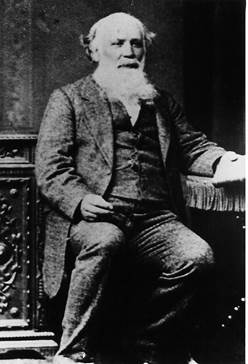 Richard Quarmby, circa 1880
Census of 1841 shows Mary aged 36 and Joseph 39, Richard 15, Henry 12,
Ruth 10, Ezra 4, Elizabeth 1. Richards
father died in 1848 and was recorded as being a woolen manufacturer, in
Huddesfield.
According to the
This census of 1851 also
states that Henry was 22, Ezra 14, Elizabeth 11 and Edwin aged 8.
Note: daughter Ruth is not recorded
In December 1852 Richard
arrived in
Richard may have stayed on
board and helped with the repairs of this ship.
1854 Richard joined the crew
of the coastal ships which sailed between the ports of
Sarah and her sister Jane
Edgar had arrived as assisted immigrants
on the
In the time that it took for
the girls to come out to
 Richard married Sarah
Edgar on
Richard married Sarah
Edgar on
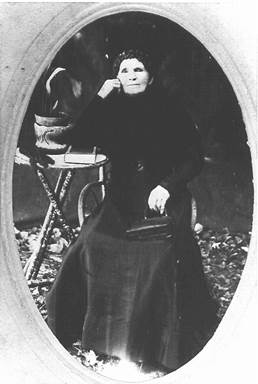
Sarah Quarmby (nee Edgar), date unknown
From February
1855 Richard wasn’t working on the coastal ships. The next record for him is on the Wonga Wonga
as a fireman in October 1855. There is a
gap of 8 months that he either worked in Sydney or Melbourne. Most likely Sydney as he was married.
29/11/1855 as steerage passengers, Richard Sarah and
Jane traveled to Melbourne from Sydney departing on 29/11/1855 on the Yarra Yarra
(Ref 1855 – P13/14)
They then traveled to Belvoir (Woodonga ) where Jane
married Henry James Harrison on the 11/9/1865.
Sarah and Richard being witnesses. By this time Sarah was 7 months
pregnant.
Their first child Matilda was born in November, 1856
at Osborne Flat,Yackandandah.
We are not sure if Richard ran the hotel for his
brother in law. The Crystal Palace was registered in James Harrison’s name and he also
had a mining lease. There is no record
of Richard having a mining lease but he is listed as a miner on the birth
certificates of his children. Either
way, the families most likely worked in together. ( Jane also had young children).Elizabeth, Edwin and Walter
were born at Osborne Flat, bringing the
family to four children.
Richard and Sarah moved on to Kiandra about 1860 to
the gold fields there and increased their family to nine.Selina, Ezra, Sarah (
Lavinia), Henry(Harry) and Rowland.
Ref: 1862- 1868 – P15)
Around 1869
Richard, Sarah and nine children packed up and moved to Reedy Flat with baby
Rowland carried on horseback by Sarah. Frederick was born there in 1870. The
family occupied a mud/brick (Pise) hut and Richard once again mined for
gold. Three more children Frederick,
Richard (Herbert) and Maud, increased
the size of the family to 13 children by 1875.
Richard was still listed as a miner on the birth certificates.
SETTLING DOWN
Richard took up land, initially 100 acres on the road
to Tumut probably in 1872- this tenure was formalised by ‘conditional purchase’
Crown Grant, in 1874. The family cleared
this land and built their first home which was slab timber from the land they
were clearing. Nothing was wasted in
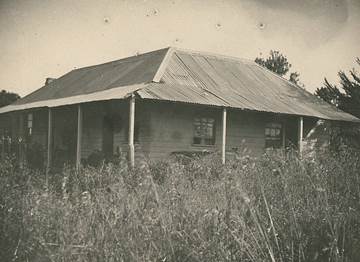
those days. Later in life another
dwelling was built – see photo. (Ref 1872 – P16)
Richard later applied for an additional 40 acres
across the road. This application was
refused as a road separated the properties. N.B. This area later formed part of Edwin’s
holdings.
 Baldy hill was at the back of this property
and the family attended church and school at Upper Adelong in those very early
days. This small township is no longer
there.
Baldy hill was at the back of this property
and the family attended church and school at Upper Adelong in those very early
days. This small township is no longer
there.
Quarmby homestead- December, 1913
(Now demolished).
We believe that Richard also
sought help to clear this heavily wooded
land from Napoleon Bonaparte Johnson and J. Adams. They had bullock teams and Richard hired them
to help clear the 100 acres. Harry
Quarmby could recall the ‘burning off’ of stumps at the early age of 8. Elizabeth Quarmby married Napoleon so she
most likely met him when the land was being cleared.
With their family of 13 Richard and Sarah settled in at
Bearing in mind
that Richard died in 1884, all this work
would have fallen thereafter to Sarah
and the family. Matilda, Elizabeth and Selina married when young. This left Lavinia to help her mother with the
household chores. Maud was a lot younger
than her brothers and sisters. Some of the older boys took up land north and
south of the family block.
Maud was possibly the only one of Richards and Sarah’s
children to attend Upper Adelong School.
She was noted for her glorious singing voice and natural aptitude for
musical instruments. Musical evenings were often held at the Quarmby’s and
often the Prowses attended as they were fellow members of the church.
We are indebted for this
extract written by Constance Sullivan in her book There’s Gold (Edited by Kitty
Barnes). It is an insight into the
lifestyles/hardships/determination that
these early pioneer’s of the Upper Adelong/Reedy Flat (Batlow) district
endured. They are our ancestors and we
should always carry our name with pride.
The Quarmbys used
to attend the Union Church in the centre of the village which served the needs
of all protestant denominations. It was
a fine sight to see the family on Sunday, when they rode to church. Mrs Quarmby’s Sunday dress was of black silk,
“so rich that it would stand alone”, covered by a long, wide-sleeved corded
silk dolman. Her boots were of black
cashmere, the usual womans wear, with patent leather V shaped toe-caps and
elastic sides. They were fitted with
loops to help in putting them on and the loops had to be pushed inside the
boots. Her bonnet was of black straw,
with upstanding aigrettes tipped with jet.
Its strings of black silk ribbon were long and wide.
Miss Lavinia, small, quiet,
dressed in grey, attended her mother.
They rode in a farm waggon behind a brisk bay horse. Two of the big sons rode on either side, and
the rest of the family either shared the wagon or brought up the rear on
horseback, horses and riders alike all spick and span.
Having alighted, Miss Lavinia
quietly straightened her mother’s garments, and removed and folded the square
of black gossamer that had protected her head while driving. The old lady waited on the wooden steps of
the church until the family had gathered, and then, holding her train in one
black—gloved hand, she moved in state up the aisle, spread her skirts and sat,
her family standing respectively by until she was quite ready, before they
seated themselves. They almost filled
the little church. Their singing did
fill it.
Constance Sullivan attended school with Maud, known as
Maudie. Maud used to sing at Upper
Adelong with Florrie Basham and the Sullivan family. She notes that the Prowses were industrious,
always doing, and doing well. When two
of the Prowse brothers decided to go to W.A. where land could be purchased for
6pence an acre, Maudie married one of them and went away forever.
 In 1878 Henry Quarmby arrived on the Aconcaqua at Port Phillip. He married Ann McCallum in 1881 in
Paddington, Sydney. This could have been
Richards brother or cousin There were no
children to this marriage although he did have children in England. He died at
Parramatta in 1896 certificate states
that his mother was Mary Miller and father was Richard Quarmby Quamby). (Ref: 1896 – P17)
In 1878 Henry Quarmby arrived on the Aconcaqua at Port Phillip. He married Ann McCallum in 1881 in
Paddington, Sydney. This could have been
Richards brother or cousin There were no
children to this marriage although he did have children in England. He died at
Parramatta in 1896 certificate states
that his mother was Mary Miller and father was Richard Quarmby Quamby). (Ref: 1896 – P17)
Richard died in 1884 at St.Vincents Hospital in Sydney . He had been ill for 2 months according to his
death certificate. Certificate states
that his mother was Marian Miller and father was Joseph Quarmby. Walter his son was present when he died.
Walter was 24 at the time and must have gone to Sydney with his father probably
by horse and cart to Gundagai station then on to Sydney by train.
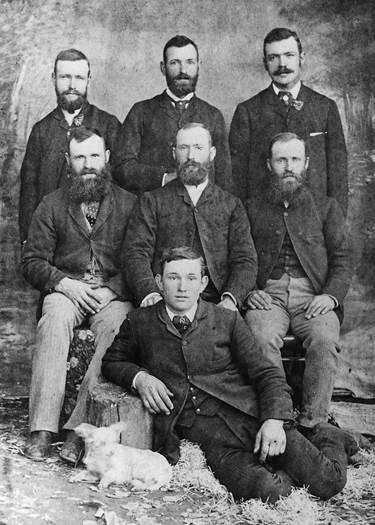
The Quarmby boys
Back: Rowland, Harry, Fred
Mid: Ezra, Walter, Edwin
Front: Albert. Missing: Herbert
(back row discrepency –
Richard (Herbert), Harry, Fred
Missing: Rowland.
1896 Henry Harrison died
and is buried in an unmarked grave at
Batlow. Jane Harrison died on
Sarah died 4 years later in
1919 and is buried in
So ended the lives of two
very courageous sisters, Jane and
Sarah. As very young girls, they left
their widowed mother and ventured to a strange land. The journey from
The two sisters stayed
together with their families for most of their lives. They raised large
families, were fine citizens and we may be sure they would be proud to see the results of their
efforts.